

A restaurant point-of-sale system can appear to cost anywhere from $0 per month to several hundred dollars per location. But the advertised software price is only one part of the bill. Hardware, payment processing, kitchen displays, online ordering, installation, support, and long-term flexibility can matter just as much.
This guide compares several credible restaurant POS options using publicly listed US pricing checked in August 2026. Prices, taxes, promotions, processing rates, and regional availability can change, so always request a written quote for your exact setup.
The five costs behind a restaurant POS
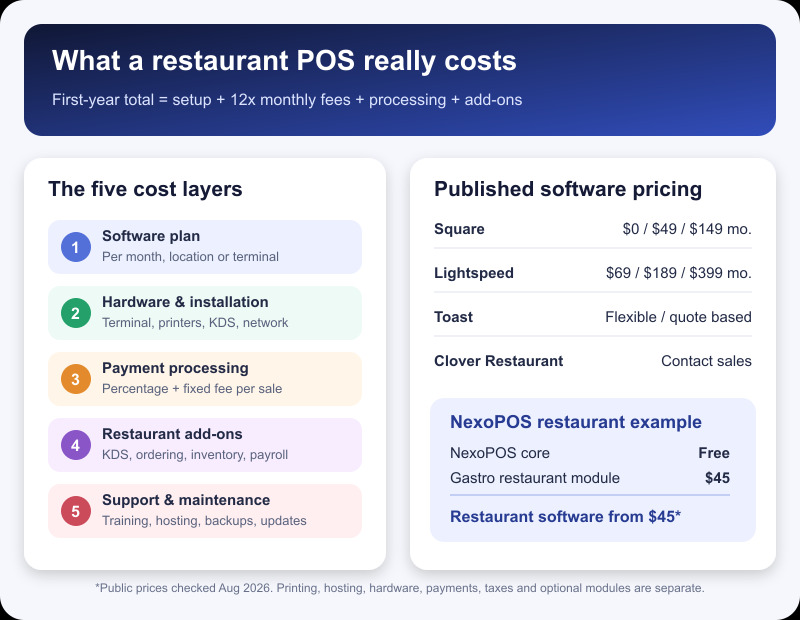
The real first-year cost of a restaurant POS includes much more than the monthly software plan.
- Software: the monthly subscription or one-time license for registers, reporting, inventory, and staff management.
- Hardware and setup: terminals, tablets, cash drawers, receipt printers, routers, installation, and staff training.
- Payment processing: a percentage and often a fixed fee on every card transaction. At volume, this can exceed the software bill.
- Restaurant add-ons: kitchen display systems, table management, online ordering, loyalty, delivery integrations, and additional locations or devices.
- Support and maintenance: vendor support, hosting, backups, upgrades, replacement hardware, and internal administration.
A useful comparison formula is: first-year total = setup costs + 12 × recurring fees + payment processing + add-ons. This prevents a low entry price from hiding a more expensive operating model.
Restaurant POS pricing: credible options
Square for Restaurant
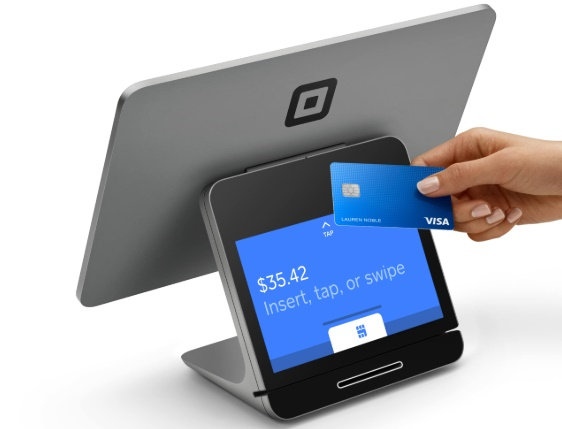
Square is approachable for small restaurants that want a bundled payment and POS experience. Its official restaurant pricing lists Free at $0, Plus at $49, and Premium at $149 per location per month. Published in-person processing rates differ by plan, and restaurant extras add to the total: for example, Square lists Kitchen Display System access at $30 per device per month on Plus and $20 on Premium. See Square's current restaurant pricing.
Lightspeed Restaurant
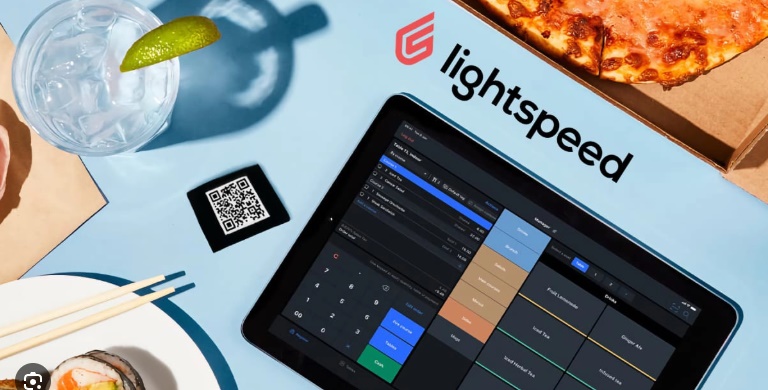
Lightspeed targets restaurants that need richer operations and multi-location capabilities. Its official page lists Starter at $69, Essential at $189, and Premium at $399 per month, with enterprise pricing by quote. A Kitchen Display System is listed at $30 per screen per month. Confirm what hardware, payment processing, onboarding, and integrations your proposal includes. See Lightspeed Restaurant pricing.
Toast
Toast is restaurant-focused and offers an integrated ecosystem spanning POS, kitchen workflows, ordering, payroll, and payments. Its current pricing page emphasizes flexible, quote-based packages; hardware and implementation vary by configuration, and Toast uses approved hardware. Ask for the complete contract cost, payment terms, add-ons, and early-termination conditions—not only the monthly software figure. See Toast pricing.
Clover Restaurant
Clover combines restaurant hardware, software, and payment acceptance in packaged configurations. Its restaurant page currently directs buyers to contact sales for Starter, Standard, and Advanced pricing. That makes the written quote especially important: compare the hardware purchase or financing cost, monthly software, processing agreement, included apps, and support. See Clover Restaurant pricing.
Why NexoPOS deserves a closer look
NexoPOS takes a different approach. The NexoPOS core is free and open source, while optional restaurant, printing, and deployment tools are available through the NexoPOS Marketplace. It is a modular, self-hostable ecosystem that lets a restaurant choose its hosting environment, compatible hardware, payment workflow, and extensions. This can be attractive to independent operators, integrators, and growing hospitality groups that want more control and prefer purchasing only the components they need.
For restaurant operations, the Gastro extension adds table and floor management, kitchen workflows and screens, modifiers, and other restaurant-specific tools. NexoPOS can therefore cover much more than checkout while remaining adaptable to the restaurant's operating model.
A transparent NexoPOS software example
- NexoPOS core: free and open source.
- Gastro restaurant extension: $45 one time.
- Nexo Print Server: $25 regular price / $15 current sale price. A free trial is available for testing before purchase.
- NPS Adapter: $15 one time when connecting NexoPOS to Nexo Print Server.
- NexoPOS for Windows: $39 one time as an optional desktop deployment path, rather than a required addition to every web installation.
Because the NexoPOS core is free, a straightforward restaurant software setup can begin with Gastro at $45 one time. If direct printing through Nexo Print Server is required, adding the $15 NPS Adapter and Nexo Print Server at its current $15 sale price brings that example to about $75 one time—or $85 when Nexo Print Server is purchased at its $25 regular price. Nexo Print Server can be tested through its free trial before purchase. These figures are software-only examples and exclude hosting, POS hardware, installation, customization, card processing, taxes, other optional modules, and paid support. Check the NexoPOS Marketplace and the Nexo Print Server page for current pricing.
The trade-off is responsibility: a self-hosted system gives you control, but somebody must manage hosting, backups, security, deployment, and support. Restaurants without technical resources may prefer a managed implementation partner. Restaurants that already have technical support—or POS providers building solutions for clients—may see substantial long-term value in NexoPOS's ownership model.
How to compare the total cost
Build the same three-year worksheet for every shortlisted system. Include every terminal and location, realistic annual card sales, all required restaurant modules, hardware replacement, support, and contract fees. A subscription POS should be calculated as 36 months of recurring charges, while NexoPOS should include the initial software components plus 36 months of hosting and maintenance.
Questions to ask before you buy
- How many registers, locations, kitchens, and display screens are included?
- Are online ordering, reservations, loyalty, inventory, and delivery integrations extra?
- Can I choose my payment processor, and what happens to the rate as volume grows?
- Is hardware purchased, leased, financed, or locked to the provider?
- What are the contract term, cancellation fee, data-export policy, and offline capabilities?
- Who handles installation, backups, security updates, staff training, and emergency support?
The bottom line
There is no single restaurant POS price because restaurants do not share the same workflow. Square can offer a low-friction starting point, Lightspeed provides tiered operational depth, and Toast or Clover can deliver tightly integrated packages through a custom quote. NexoPOS stands out when control, modularity, and a lower one-time software entry cost are priorities.
For a restaurant that can manage hosting—or work with a capable implementation partner—the free NexoPOS core and $45 Gastro extension provide an accessible starting point before printing tools, infrastructure, and services. The best decision is the one based on a complete three-year cost and a live test of the exact restaurant workflow.